
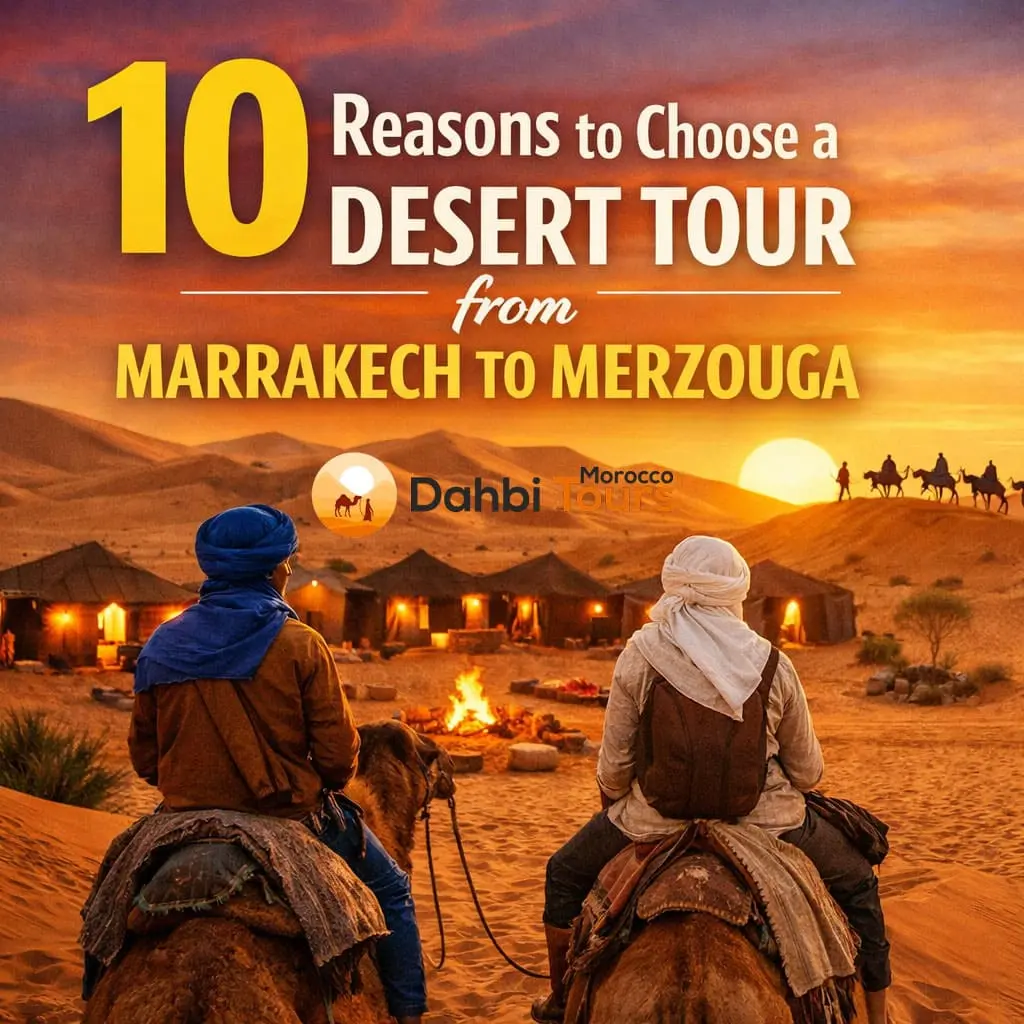
from Marrakech to Merzouga
Introduction
There is a moment, somewhere on the road between the rose-red walls of Marrakech and the infinite silence of the Merzouga dunes, when Morocco stops being a destination and becomes a feeling. The air thickens with wild thyme, the Atlas peaks recede behind you, and the Sahara—vast, gold, and unhurried—rises to meet you.
A desert tour from Marrakech to Merzouga is not simply a sightseeing trip. It is a journey through Morocco’s many faces: mountain passes dusted with snow in winter, oasis valleys stitched with date palms, ancient kasbahs crumbling beautifully back into the earth, and finally, the soft copper silence of the Erg Chebbi dunes at the edge of the Sahara. Few itineraries on Earth pack this much contrast, beauty, and cultural depth into three or four days of travel.
Whether you are a couple seeking romance under a canopy of desert stars, a solo adventurer hungry for something off the standard tourist trail, or a family building memories that will outlast any photograph—this route delivers. Read on for ten compelling reasons why a Marrakech to Merzouga desert tour should sit at the very top of your Morocco itinerary.
What Is a Desert Tour from Marrakech to Merzouga?
In its most common form, a Sahara desert tour from Marrakech runs over three days and two nights, covering roughly 1,000 kilometres of Morocco’s most spectacular terrain. The journey typically unfolds in stages:
- Departure from Marrakech at dawn, heading south through the High Atlas Mountains via the Tizi n’Tichka pass (2,260 m).
- A stop at Aït Benhaddou—the UNESCO World Heritage ksar that has served as a backdrop for Gladiator, Game of Thrones, and dozens of other productions.
- Continuing through the Valley of Roses, the Drâa Valley, and the cinematic landscapes around Ouarzazate—Morocco’s so-called “Hollywood of the Desert.”
- Arrival at the Merzouga dunes by late afternoon, timed so your first sight of the Erg Chebbi is bathed in the amber light of the setting sun.
- A camel trek into the Sahara, an overnight stay in a desert camp, sunrise over the dunes, and a scenic return to Marrakech on day three.
Extended versions — four, five, or more days — allow for deeper exploration of kasbahs, gorges, Berber villages, and oasis towns that most travelers never reach. Whichever length you choose, the core experience remains the same: a genuine immersion into a Morocco that feels utterly ancient and absolutely alive.
10 Reasons to Choose This Tour
1. The Landscapes Are Unlike Anything Else in the World
This route is essentially a greatest-hits reel of Moroccan geography. You begin in the olive-green foothills of the High Atlas, climb to snowcapped passes, drop into pre-Saharan valleys the color of burnt ochre, wind through black volcanic hammadas, and arrive at the living amber sea of the Erg Chebbi. Each stretch of road looks like a different country. For photography enthusiasts in particular, every bend in the road presents a composition they never anticipated. There are few drives in the world this cinematically rewarding.
2. The Sahara Sunrise Is a Once-in-a-Lifetime Moment
Wake before the world. The desert camp is silent except for the soft creak of tent canvas in the pre-dawn wind. Your guide leads you up the ridge of the nearest dune—legs burning pleasantly in the cool sand—and you sit and you wait. Then, at the precise moment the horizon cracks open with gold, the entire Sahara transforms. Every grain of sand catches the light differently. You realize you’ll remember this silence, this color, and this moment for life as the shadows lengthen and sharpen. No photograph fully captures it. You simply have to be there.
3. Camel Trekking into the Sahara
There is something deeply satisfying about the rhythm of a camel. Unhurried. Swaying. Indifferent to your sense of urgency. The camel trek from your desert camp into the heart of the Erg Chebbi dunes takes roughly forty-five minutes each way, and during that time the world simplifies completely. No Wi-Fi. No notifications. Just the crunch of sand underfoot, the warmth of the sinking sun on your shoulders, and the strange privilege of approaching one of the world’s great natural wonders on the back of an animal that has been doing precisely this for thousands of years.
4. Overnight in a Luxury Desert Camp
Sleeping in the Sahara used to mean roughing it, but not anymore. Today’s luxury desert camps in Merzouga have well-furnished tents with real beds, handwoven Berber rugs, lantern light, and, in many cases, private bathrooms. After dinner, which was a slow, communal spread of Moroccan tagine, fresh bread, and mint tea, your host lights a campfire. Musicians show up with a bendir drum and a sintir bass lute, and the night sky opens up above you, so thick with stars that it feels like a building. It is romance and adventure that come together easily.
5. Cultural Immersion with the Amazigh (Berber) People
The Amazigh of Morocco, the first people to live there, whose culture is thousands of years older than the Arabs, are the heart of this trip. Amazigh himself is probably your guide, and he has family ties to the villages you pass through. You will hear bits and pieces of Tamazight, the native language. You might be asked to come over for tea. You will sit with families in the palmeries of the Drâa Valley and start to see that hospitality here is not just a nice thing to do; it’s a way of life. No city tour can give you this kind of real cultural exchange.
6. UNESCO History at Every Turn
The route passes through some of Morocco’s most historically significant sites. Aït Benhaddou, the mud-brick citadel rising from the floor of the Ounila Valley, is a UNESCO World Heritage Site representing the apex of southern Moroccan earthen architecture, still partially inhabited by local families. Further along, the kasbahs of the Drâa Valley tell the story of trans-Saharan caravan routes that once made this region one of the wealthiest corners of the medieval world.
7. It Is Perfect for Couples and Honeymooners
If there is a more romantic setting for a private dinner than a luxury tent beneath the Sahara stars, we have not found it. The Morocco desert tour Merzouga route consistently appears on international honeymoon lists, and for good reason. Private tours offer complete flexibility: you stop where you want, linger where you fall in love, and arrive at the dunes as the light reaches its most golden. Many operators offer sunset setups on the dunes, private camp configurations, and itineraries designed entirely around the couple’s pace.
8. Adventure Without Sacrificing Comfort
One of the most appealing aspects of a well-planned 3 days desert tour Marrakech to Merzouga is that it manages to feel genuinely adventurous without leaving you uncomfortable. You travel in a climate-controlled 4×4. Your accommodations are carefully vetted. Your meals are fresh and generous. The adventure—the dune climb, the camel ride, and sleeping under the open sky— arrives in curated doses that feel exhilarating rather than exhausting. It is equally suited to first-time travelers and seasoned explorers.
9. The Route Is Rich with Cinematic Detours
The Todra Gorge—a sheer-walled canyon of rose-colored limestone rising 300 meters above a rushing river — is reason enough alone to take the longer route. The ancient fossils embedded in the rocky plains near Erfoud, the silver and turquoise of the Berber jewelry markets, and the oasis town of Tinghir, where children play in the shade of date palms while men cheerfully argue over the price of saffron, are also present. Every detour feels like a deleted scene from a film you wish had existed.
10. Exceptional Value for a Transformative Experience
Compared to what a trip of similar emotional impact costs in Patagonia, Iceland, or the Jordanian desert, a private best-desert tour Morocco itinerary represents remarkable value. A well-run three-day private tour—including a licensed driver-guide, 4×4 transport, accommodation, most meals, a camel trek, and a desert camp—costs a fraction of comparable adventure travel elsewhere. For first-time visitors to North Africa, it is also a remarkably safe and accessible entry point into a culture of extraordinary depth.
A Word on Choosing the Right Operator
All of the above are true—but only when you travel with a team that genuinely knows this land. The quality of a desert tour rises and falls almost entirely on the guide sitting beside you.
For travelers serious about doing this route well, Dahbi Morocco Tours has built a strong reputation as one of the most trusted private operators on the Marrakech–Merzouga corridor. Family-run, locally rooted, and licensed by the Moroccan Ministry of Tourism, the team designs private itineraries that go beyond the standard circuit—incorporating hidden kasbahs, authentic family guesthouses, and the kind of impromptu moments that never appear in any brochure. If you are ready to explore options, their desert tour from Marrakech to Merzouga page is an excellent starting point for understanding what a well-crafted Sahara itinerary looks like.
Why Booking with a Local Tour Operator Matters
In an age when every major booking platform offers some version of a “Morocco desert experience,” the difference between an adequate trip and a genuinely memorable one almost always comes down to one variable: local knowledge.
Trust and Safety Come First
A licensed Moroccan tour operator is accountable to the Ministry of Tourism, carries proper insurance, and works within a framework of obligations that informal operators do not. When you are traveling through remote mountain passes and arriving in a desert at nightfall, that accountability matters far more than it seems during the booking process.
Access to the Unofficial Morocco
Local operators know which guesthouse has the best home cooking in the Drâa Valley, which side road leads to a waterfall that doesn’t appear on Google Maps, and which family in Merzouga hosts the most authentic music evenings. You won’t find these details in a review. They are built over years of genuine community relationships.
Flexible, Human Itineraries
Large tour groups operate on rigid schedules. A private local operator moves at your pace. Fell in love with the Todra Gorge and want to stay another hour? Done. Want to skip the tourist shops and go directly to the dunes? Done. This flexibility is the difference between a tour and a journey.
Tips for Choosing the Best Desert Tour in Morocco
- Prioritize private over group tours. Shared minibus tours are cheaper but sacrifice flexibility, pace, and personalization. A private 4×4 with a licensed guide transforms the experience entirely.
- Check the specific camp before you book. Ask for photos or reviews of the exact camp used. Luxury and standard camps vary enormously, and the overnight stay is central to the trip.
- Verify licensing. Your operator should hold a valid license from the Moroccan Ministry of Tourism. Ask for it if you are unsure.
- Read guide-specific reviews. The guide is the tour. Look for reviews that name your guide specifically and describe the depth of their knowledge.
- Clarify what is included. Camel treks, meals, water, and entrance fees should all be itemized. Hidden extras are a common source of disappointment.
- Consider extending the route. Four or five days, incorporating the Todra Gorge or Drâa Valley, turn a wonderful trip into an extraordinary one.
What to Pack for a Desert Tour
The temperature swing between the mountain pass and desert floor can exceed 25°C in a single day. Pack accordingly:
- Lightweight layers and a warm fleece for mountain passes
- A proper jacket for desert nights (even in summer, nights are cold)
- Breathable long-sleeved shirts for sun protection
- Comfortable closed-toe shoes for dune climbing
- High-SPF sunscreen and lip balm
- A headscarf or shemagh for dust and sun
- Reusable water bottle (minimum 1.5 litres)
- Headlamp with spare batteries
- Cash in Moroccan dirhams (ATMs become scarce after Ouarzazate)
- A camera with a dustproof bag or case
Frequently Asked Questions
How long is the desert tour from Marrakech to Merzouga? The standard tour runs for 3 days and 2 nights, covering approximately 1,000 km in return. Extended options of 4, 5, or 6 days are available for travelers who want to explore additional regions without feeling rushed.
Is a Marrakech to Merzouga desert tour worth it? Without qualification, yes. It consistently ranks as one of the top experiences of an entire Morocco trip—and frequently of an entire year of travel. The combination of landscapes, cultural encounters, and the Sahara overnight is simply not replicable anywhere else in the region.
Is the desert tour safe for solo travelers? Yes. Morocco is considered one of the safer destinations in the Arab world for international tourists, and this route is well-established and regularly traveled. Booking with a licensed private operator significantly reduces any risk. Solo women travelers regularly take this tour without incident.
What is the best time of year for this tour? October through April offers the most comfortable temperatures, with pleasant days and cool but manageable nights in the desert. Summer heat in Merzouga regularly exceeds 45°C. Winter trips, particularly December to February, offer a striking contrast between snow on the Atlas passes and warm desert afternoons.
How much does a 3-day desert tour from Marrakech cost? A private 3-day tour for two people—including licensed guide-driver, 4×4 transport, guesthouse accommodation, a desert camp, most meals, and a camel trek—typically ranges from €180 to €300 per person. Always request a fully itemized quote and be cautious of unusually low prices, which often reflect compromises on camp quality or guide experience.
Can I customize the itinerary? Absolutely. A reputable private operator will build your itinerary around your interests, pace, and travel dates. Whether you want an extra night in the desert, a detour through the Drâa Valley, or a return route via Fez, these adjustments are standard practice.
Do I need vaccinations or special insurance for Morocco? No specific vaccinations are required for entry. Standard travel health precautions apply — consult your GP before departure. Comprehensive travel insurance covering medical evacuation is strongly recommended, as the route passes through remote terrain far from major hospitals.
Conclusion
A desert tour from Marrakech to Merzouga is one of those rare experiences that exceed expectation—not because it surprises you with something unexpected, but because it delivers fully the thing you came for: silence, scale, beauty, and a reminder that the world is older and stranger and more magnificent than daily life allows you to remember.
You will stand on a dune at sunrise with hundreds of kilometers of Sahara between you and the horizon, and something will shift. That is the point. That is the whole point.
When you are ready to plan your journey south, the team at Dahbi Morocco Tours is there to help you design it properly—with local knowledge, genuine care, and an itinerary built around you. Start planning at dahbi-moroccotours.com.
Published by Dahbi Morocco Tours — Licensed Private Tour Operator, Ouarzazate, Morocco.