
Introduction
Some journeys change the way you see the world. A desert tour from Marrakech to Merzouga is one of them.
You know this isn’t a normal trip as soon as you leave Marrakech and the city’s rooftop noise fades into the vast silence of the High Atlas Mountains. The landscape changes so much over the course of three, four, or more days—from snow-capped passes to volcanic plains, from ancient mud-brick citadels to the soft copper silence of the Sahara—that the experience stays with you long after you get home.
The legendary Erg Chebbi dunes in Merzouga are the most emotional part of any trip to Morocco. But the trip itself and everything that happens along the way are just as important. The kasbahs, the Berber villages, the palm oases, and the mint tea on the side of the road all add to an experience that can’t be summed up in a highlight reel.
This guide shows you the best things to do on this famous route, why each is important, and how to make the most of every minute between Marrakech and the Sahara.
1. Crossing the High Atlas Mountains via Tizi n’Tichka
The journey south begins with one of Morocco’s most dramatic drives.
At 2,260 meters above sea level, the Tizi n’Tichka pass is the highest road pass in North Africa. The road below winds through Berber villages made of pale stone that look like they grew right out of the mountainside. In the winter, the peaks on either side are covered in snow. The slopes turn green in the spring, and wildflowers push through the rocks. The views are amazing all year round.
Your driver-guide will know exactly where to stop: on a ridge that gives you a full view of the Atlas, at a roadside stall that sells handmade fossils and ammonites from the Jurassic seabed that used to cover this area, or in a village where old women sell small rounds of fresh bread baked over an open fire.
This isn’t just a road that goes somewhere. This is the first chapter of the story.
2. Aït Benhaddou — A UNESCO World Heritage Kasbah
Few stops on the Marrakech to Merzouga route generate as much genuine awe as Aït Benhaddou.
This ancient ksar rises from the floor of the Ounila Valley like a fortress that a medieval architect with a flair for drama might have imagined. It is a UNESCO World Heritage Site and one of the best examples of southern Moroccan earthen architecture still standing. The towers and walls are made of pisé, a mix of clay, straw, and gypsum, and they glow amber at dawn and deep gold at dusk.
Some people still live on the site. A few families still live inside, and as you climb through the narrow passages to the top, you might see a woman hanging laundry, kids chasing a cat through an archway, or an old man sitting in a doorway with a glass of tea on his knee. Here, history isn’t something that’s behind a rope. It breathes.
People who love movies will know the setting right away: Aït Benhaddou has been in Gladiator, Lawrence of Arabia, Game of Thrones, Babel, and many more. But no movie can fully capture the size or the quiet of being there in person.
3. Ouarzazate — Morocco’s Cinematic Capital
Just forty kilometres east of Aït Benhaddou, the town of Ouarzazate offers a different kind of experience.
Ouarzazate is known as the “Hollywood of the Desert.” It has two major film studios, Atlas Corporation Studios and CLA Studios, that have been making movies for 50 years. Going to the studios is an optional but fun stop, especially for movie fans who want to see sets that have stood in for ancient Rome, biblical Jerusalem, and the streets of Marrakech in the 1920s.
Ouarzazate is a good place to spend your first night on the way, even outside of the studios. The town has nice restaurants, cozy guesthouses, and a slow pace that makes it feel like a real transition point between the busy city of Marrakech and the wide-open desert ahead.
The Taourirt Kasbah is a huge 17th-century fortress on the edge of town that used to belong to the powerful Glaoui family. It’s one of the most underrated historic sites in southern Morocco and is worth an hour of your time.
4. The Drâa Valley—Morocco’s Ancient Caravan Route
South of Ouarzazate, the landscape opens into the Drâa Valley — arguably the most beautiful stretch of road in the entire country.
The road follows the Drâa River for about 130 kilometers, passing through a series of oasis villages, date palm groves, and mud-brick kasbahs. For hundreds of years, this was the main caravan route across the Sahara. It linked sub-Saharan Africa to the markets in Marrakech and Fez. This valley was a trade route for gold, salt, slaves, and spices for a thousand years. The kasbahs that line the way—Tamnougalt, Timiderte, and Agdz—are the fortified remains of that time, still standing against the light of the desert.
The palm trees here are amazing. There are narrow irrigation channels running under thousands of date palms, fig trees, and pomegranate bushes. Chickens walk around in open courtyards. Women in colorful dresses carry big bundles of firewood on their heads. Life in the Drâa hasn’t changed much in the last hundred years, and spending time here, even just an hour, will change how you think about time in a way that no guided tour of a museum ever could.
5. The Todra Gorge — One of Morocco’s Natural Wonders
For travelers taking a four-day or longer itinerary, the Todra Gorge is an unmissable detour.
The gorge cuts through the High Atlas foothills near the town of Tinghir, its sheer limestone walls rising nearly 300 metres on either side of a narrow river. At the narrowest point, the walls close to within ten metres of each other, channeling the light into a pale blue column that shifts as the sun moves. It is one of those places where photographs, however well composed, fail to communicate scale.
The gorge is popular with rock climbers from across Europe, and fixed bolt routes run up the walls at various grades. For non-climbers, a walk along the riverbank—sometimes wading through ankle-deep water between boulders— is equally rewarding. Several small cafés at the canyon entrance serve mint tea and Berber omelettes while you watch the cliff faces change color through the afternoon.
The Todra Gorge is accessible on the 4-day Marrakech to Merzouga tour offered by Dahbi Morocco Tours, which builds in genuine time at the gorge rather than a rushed roadside stop.
6. Arriving at the Erg Chebbi Dunes
There is no adequate way to prepare someone for their first sight of the Erg Chebbi.
The drive from Rissani to Merzouga goes over a flat, stony hammada, which is a treeless, colorless area of gravel and rock. It feels like a long pause before something important, whether you meant to or not. And then, out of nowhere, the dunes show up. Not slowly. All at once. A wall of orange and amber that rises 150 meters from the flat ground and stretches 22 kilometers from north to south. In the late afternoon sun, it looks like something that was put there by a civilization that was good at theater.
The Erg Chebbi is not the biggest dune field in the Sahara, but it is one of the most beautiful, and it is also one of the easiest to get to in Morocco because it is close to the village of Merzouga. The sand’s color changes all the time with the light. At noon, it’s pale gold; in the late afternoon, it’s copper; at sunset, it’s deep rust; and under a full moon, it’s silver.
If your driver has timed the route well, which a good guide always does, you will get there with just enough light left to see the dunes at their most dramatic before it gets dark.
7. Camel Trekking into the Sahara
This is the moment that most travelers have imagined since they first started planning a Morocco trip.
Your cameleer — usually a young Sahrawi man from a nomadic family with an intimate knowledge of the dune topography — will assign you your camel with the casual authority of someone who has done this ten thousand times. The camel will regard you with a magnificent indifference. You will climb on, the animal will lurch to its feet in its characteristic two-stage rise, and you will be moving.
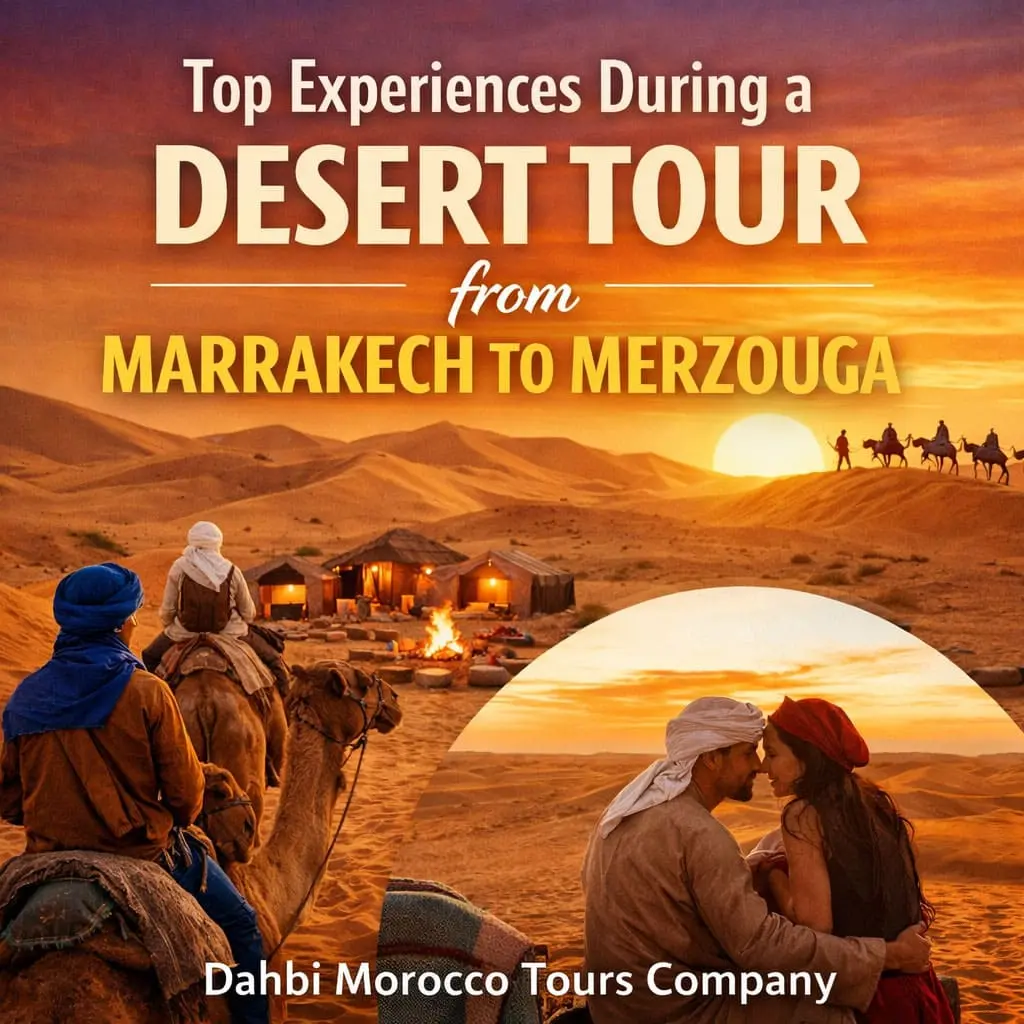
The trek to the overnight camp takes between forty minutes and an hour, depending on the route taken and the pace of the group. During that time, the world becomes very simple. The sound of the caravan. The warmth of the sand radiating upward. The slow erasure of the distant village lights as the dunes close around you. The sky, in the absence of light pollution, begins to fill with stars while it is still faintly orange on the western horizon.
Camel trekking is included as standard in all desert itineraries offered by Dahbi Morocco Tours, from the compact 2-day tour from Marrakech to Merzouga to the extended multi-day routes.
8. Overnight in a Sahara Desert Camp
The desert camp experience is the emotional center of the entire journey, and its quality depends almost entirely on the camp your operator chooses.
A well-appointed luxury camp in the Merzouga area will offer furnished tents with proper beds, quality linen, private bathrooms or shared facilities kept to a high standard, and dinner served under the open sky. After the meal—typically a Moroccan spread of salads, harira soup, slow-cooked tagine, and fresh khobz bread, finished with sweet Medjool dates and mint tea—the fire is lit and the evening begins.
What happens next is difficult to describe in practical terms. A musician plays. Conversation slows to a murmur. The fire throws light against the curve of the nearest dune. Someone lies back and starts counting stars. Someone else falls silent for twenty minutes and comes back looking like they have worked something out.
The Sahara at night has a quality that is both profoundly peaceful and faintly vertiginous — as though the scale of the sky above you is simultaneously comforting and slightly unnerving. Sleep, when it comes, is deep.
9. Sahara Sunrise — The Most Photographed Moment in Morocco
Set your alarm for an hour before dawn.
Your guide will be waiting outside the tent with glasses of hot Berber tea. The desert at this hour is genuinely cold—even in the summer— and the silence is so complete that you can hear your own heartbeat. You will climb the nearest dune together, finding footing in the cool sand, and position yourself at the crest before the light begins.
What follows is one of those experiences that travel writers attempt to describe and photographers attempt to capture, with the shared understanding that both mediums fall short. The first thread of light on the eastern horizon turns the sky rose and violet. The dunes below shift from grey to gold to amber in the space of minutes. Shadows stretch and lengthen. The texture of the sand, so uniform in the afternoon, reveals itself in the low raking light as an intricate landscape of ripples, ridges, and hollows.
By the time the sun is fully above the horizon, you will have photographs you will never delete and a memory that requires no photograph at all.
10. Berber Music and Stargazing Around the Campfire
The desert camp’s evenings are their own unique experience, slow and unplanned in a way that seems to be getting rarer and rarer.
The campfire is where everyone meets after dinner. Many Sahrawi musicians play traditional percussion and strings, like the bendir frame drum, the sintir bass lute, and the krakebs castanets. The music is more of an invitation than a performance. At first, guests join in the rhythm badly, but after a cup of tea and some gentle encouragement, they do it less badly. These songs are old. Some are religious. Some people sing stories about the desert that have been sung for generations over the same sand.
The Milky Way stretches across the sky from one horizon to the other, and the clarity is truly shocking to anyone who is used to city skies. The desert sky over Merzouga is one of the best places in the northern hemisphere to see stars because there is no light pollution for hundreds of kilometers in most directions. Bring a star map app, or just trust your guide; most of them know the constellations in three languages and can spot a shooting star before you even notice it moving.
11. Visiting a Nomadic Berber Family
One of the most quietly memorable experiences available on this route — and one that many travelers overlook — is a visit to a nomadic or semi-nomadic Amazigh family in the desert or the palmeries of the Drâa.
These encounters, arranged through a local guide with genuine community ties, are not performances. They are invitations. You will sit cross-legged on woven blankets inside a dark, cool tent. Tea will be prepared with ceremony — three glasses minimum, poured from height to create the essential foam. Conversation, mediated by your guide, moves between languages and lands somewhere in the territory of genuine exchange.
You will likely leave having been given something — a small piece of bread, a date, a fragment of Arabic blessing — and understanding, at a level that no museum exhibition has ever conveyed, what the word “hospitality” means in a culture built around the logic of the desert.
12. The Return Route — A Different Road, a Different Morocco
A well-planned itinerary does not simply reverse the outbound route.
Returning from Merzouga to Marrakech via a different road — through the Ziz Valley, the cedar forests of Midelt, and the Zad Pass — opens up an entirely different face of Morocco. The landscape shifts from Saharan to alpine. The towns change character. The food, the accents, the architecture — all subtly different from the south.
For travelers combining a desert journey with a move to another city, the Marrakech to Merzouga tour connects naturally to a wider Moroccan circuit. The Marrakech to Fes desert tour over 3 days offered by Dahbi Morocco Tours is one of the most popular extended options, linking the two imperial cities through the Sahara and ending with arrival in Fes — allowing travelers to experience Morocco’s north after its deep south without retracing a single kilometre.
How to Choose the Right Itinerary Length
The Marrakech to Merzouga route can be done in two days at the absolute minimum, or stretched over a week for travelers who want to go deep rather than fast. Here is a practical breakdown:
2 Days — For travelers with limited time. Covers the essential route with a single desert night. Best for those who have already visited southern Morocco and want to return specifically for the Sahara experience. Dahbi Morocco Tours offers a focused 2-day tour from Marrakech to Merzouga designed around this exact need.
3 Days — The most popular choice. Allows time for Aït Benhaddou, the Drâa Valley, arrival at the dunes, an overnight in the Sahara, and a comfortable return. The 3-day desert tour from Marrakech to Merzouga balances depth and pace without feeling rushed.
4 Days — Recommended for first-time visitors. Adds the Todra Gorge, the Dades Valley, and more time in the palmeries. The 4-day Marrakech to Merzouga tour is the route most likely to produce the feeling that you have actually seen southern Morocco rather than passed through it.
5+ Days — For those who want to go further. Opens up the Figuig oasis, the Tafilalet palm grove, Erfoud and its fossil markets, the Rissani souk, and a return through Fes or Chefchaouen. Speak directly with the team at Dahbi Morocco Tours about building a bespoke extended itinerary.
Why Dahbi Morocco Tours Company ?
Planning any of these experiences well requires a team with genuine roots in the region — people who know the road not as a route on a map but as a sequence of places they have spent their lives learning.
Dahbi Morocco Tours is a family-run, licensed private tour operator based in Morocco, specializing in bespoke desert journeys for international travelers from the US, UK, and Europe. Every itinerary is built around a specific traveler—their pace, their interests, and their travel dates— rather than adapted from a standard group package.
The guides are local. The camps are vetted personally. The vehicles are maintained to a high standard. And the company’s reputation, built over years of consistent five-star reviews from independent travelers, reflects a genuine commitment to the kind of experience that earns its place in your permanent memory rather than your photo archive.
For anyone considering a Sahara journey, the best starting point is the 3-day desert tour from Marrakech to Merzouga — their most requested itinerary and the one that most consistently delivers everything described in this guide.
Practical Tips Before You Go
Best time to travel: October to April for comfortable temperatures. Winter (December–February) offers stunning contrasts between Atlas snow and desert warmth. Avoid July and August unless you are specifically seeking extreme heat.
What to wear: Layers are essential. A mountain pass and a Sahara afternoon on the same day can differ by 25°C. Long-sleeved shirts offer sun protection on the dunes. Closed-toe shoes are far better than sandals for camel trekking.
Currency: Carry cash in Moroccan dirhams from Marrakech or Ouarzazate. ATMs become unreliable east of Ouarzazate and are rare near Merzouga.
Photography: The best light on the dunes is the thirty minutes after sunrise and the thirty minutes before sunset. Everything else is adequate; those windows are extraordinary.
Health: No vaccinations are required for Morocco. Comprehensive travel insurance covering medical evacuation is strongly recommended. Drink bottled or filtered water throughout the journey.
Connectivity: Mobile signal is intermittent through much of the Atlas and patchy in Merzouga. Download offline maps before departure. Consider the disconnection a feature rather than a problem.
Frequently Asked Questions
What is the most popular desert tour length from Marrakech? The 3-day itinerary is the most popular choice among international travelers. It covers the key highlights — Aït Benhaddou, the Drâa Valley, the Erg Chebbi dunes, and the desert overnight — at a pace that feels neither rushed nor overstretched.
Is the Sahara desert tour from Marrakech suitable for children? Yes. Families travel this route regularly and children consistently rate the camel trek and desert camp as among the best experiences of their lives. Guides adjust the pace for family groups and most camps can accommodate family tent configurations.
Can I combine the desert tour with a visit to Fes? Absolutely. The Marrakech to Fes desert tour over 3 days is specifically designed for travelers who want to experience the Sahara while moving between Morocco’s two most historically significant cities.
What is included in a typical desert tour package? A standard private tour includes licensed guide-driver, 4×4 transport, guesthouse and desert camp accommodation, most meals, and the camel trek. Always request a fully itemized itinerary before booking and confirm what is and is not included.
How physically demanding is the tour? The tour is suitable for all fitness levels. The camel trek is gentle and short. Dune climbing is optional. The main physical requirement is the ability to sit comfortably in a vehicle for several hours each day. That said, those who want more physical activity — dune running, gorge hiking, off-road walks — will find plenty of opportunity.
Is it possible to do the tour in a private vehicle? Yes, and it is strongly recommended. Private 4×4 tours with a dedicated guide deliver a dramatically better experience than shared minibus group tours, allowing flexible stops, personalized pace, and access to locations that group itineraries skip.
Conclusion
A desert tour from Marrakech to Merzouga is not a single experience. It is a sequence of them — each distinct, each irreplaceable, and each contributing to something larger than the sum of its parts.
The UNESCO kasbah at dawn. The palm oasis at noon. The dune ridge at sunset. The campfire at midnight. The horizon at sunrise. None of these moments are interchangeable, and none of them fully prepare you for the next.
What you take home is not a checklist of sights visited. It is something harder to name — a recalibration of scale, a renewed sense of what the world looks and feels and sounds like when it is given space to be itself.
When you are ready to plan your journey, the team at Dahbi Morocco Tours is ready to help you design it properly. Start with the 3-day desert tour from Marrakech to Merzouga and build from there.
The Sahara has been waiting a long time. It will wait for you. But there is no good reason to keep it waiting much longer.
Written in collaboration with the editorial team at Dahbi Morocco Tours — licensed private tour operator, Marrakech, Morocco.