
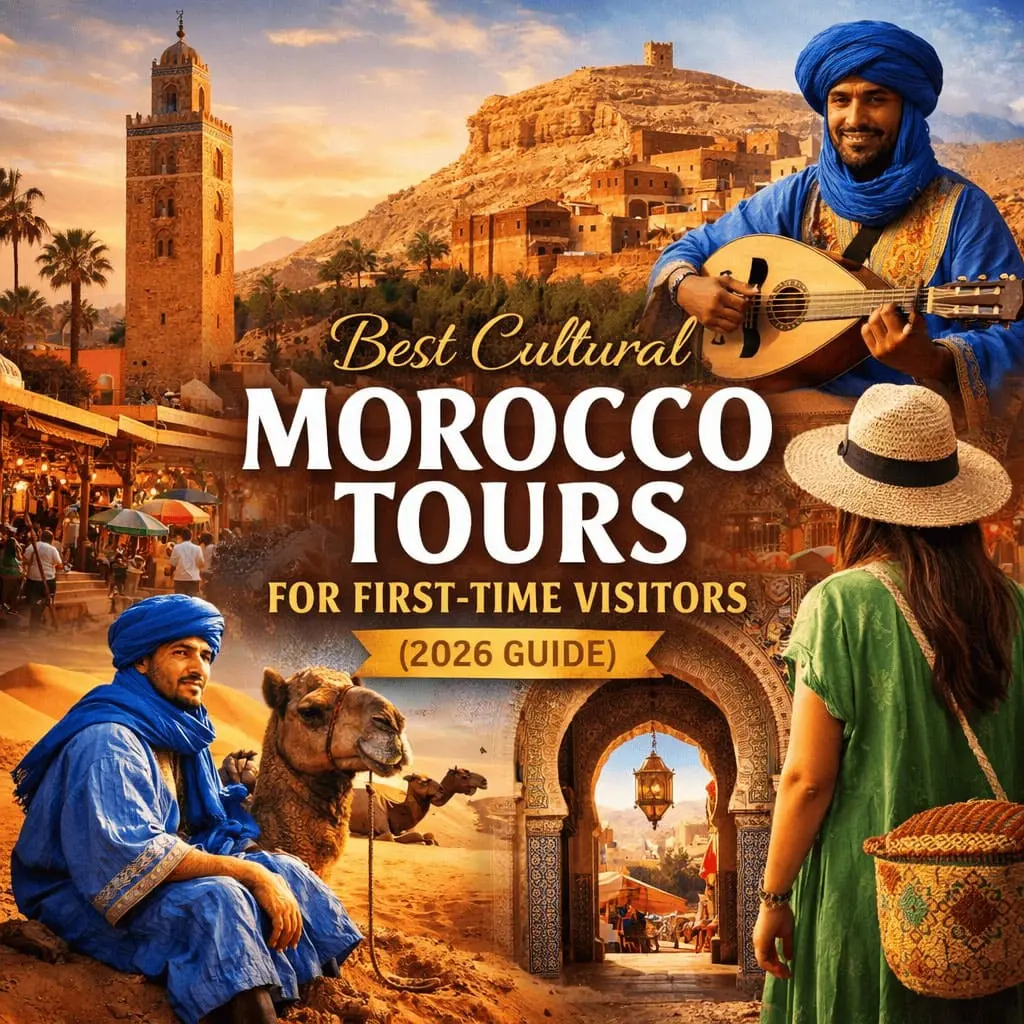
Morocco Cultural Tours for First-Time Visitors: The Complete 2026 Guide
By Dahbi Morocco Tours | Updated January 2026 | 12 min read
There is a moment when Morocco stops being a place to visit and becomes something you feel in your heart. Every first-time visitor describes this moment differently. For some, it comes to Fez, where the smell of saffron and pigeon dung hits them before the view does, at the edge of the Chouara tannery. For some, it happens later, on the edge of the Sahara, when the silence after sunset is so complete that it has a feel to it. No matter what form it takes for you, one thing is almost certain: you won’t be ready for it and you won’t want to leave.
This guide is here to help you see the real Morocco, not the postcard version or the quick highlight reel. It’s the layered, living culture that has been growing for more than twelve centuries. The Dahbi Morocco Tours team, a licensed, Moroccan-owned private tour company based in the country we call home, wrote it. We run cultural Morocco tours for travelers from the USA, UK, and Europe, and we have watched hundreds of first-timers walk away permanently changed. Here is everything we know.
Why Morocco Is a First-Timer’s Dream Cultural Destination
What makes Morocco different from other cultural destinations
Morocco is in a place on the map that is very different from most other places. It is African, Arab, Amazigh (Berber), Andalusian, and Mediterranean all at the same time. It has taken in conquerors, kicked out colonizers, and made something unique out of all of it. The food, the buildings, the music, and the way people act all have this layered history. When you come here, you are not going to see a culture. You are at the place where many great civilizations came together and never really broke apart.
For people who have never been there before, this means that there is a lot of experience that is very rare. You can walk through a medina whose street grid hasn’t changed much since the 9th century, sleep under canvas in the Sahara, eat tagine slow-cooked over charcoal in a family riad, and watch craftspeople make zellige tilework using methods that have been passed down for generations. Morocco is one of the best places in the world to experience culture because it has a wide range of things to see and do, from ancient to modern, urban to wild, and small to huge.
The four cultural pillars of Morocco
To understand what a cultural Morocco tour actually covers, it helps to think in terms of four pillars that structure almost every itinerary.
The imperial cities—Fez, Marrakech, Meknes, and Rabat— are the historic and spiritual heart of the country. Each of these cities has served as a seat of power at some point in history, and each possesses its own unique character. Fez el-Bali, the ancient walled city, is the largest car-free urban area in the world and a UNESCO World Heritage site. Walking its 9,000-plus alleyways without a guide is less a romantic adventure than a reliable way to spend three hours going in circles. Marrakech is louder, more theatrical, built for spectacle—the Jemaa el-Fnaa square at dusk, with its snake charmers, storytellers, and smoke from a hundred food stalls, is one of the great public performances on earth.
The Kasbahs and the South — the ancient earthen fortresses of the Drâa Valley and the Dades Gorge—represent a completely different Morocco: quieter, ochre-colored, stacked against canyon walls and palm groves. Aït Benhaddou, on every list of Morocco’s most photogenic sites, is a functioning ksar (fortified village) that has been inhabited for over a thousand years.
The Berber (Amazigh) heartland—the Atlas Mountains and pre-Saharan valleys: is where Morocco’s indigenous culture is most visible and least filtered. Village life here moves at a pace set by altitude and season. Hospitality is not a performance; it is an obligation, and refusing mint tea from a Berber household is considered genuinely rude.
Saharan Culture: often reduced to a camel ride at sunset but is far richer than that. The desert communities of Merzouga and M’Hamid have their own distinct traditions, including the Gnawa music that originated with sub-Saharan enslaved people brought to Morocco along trans-Saharan trade routes and that today sits on UNESCO’s Intangible Cultural Heritage list.
Best time to visit Morocco for a cultural tour
Morocco is a year-round destination, but the experience shifts considerably by season.
March to May is widely considered the optimal window. Temperatures in the medinas are comfortable (18–26°C), the Atlas passes are open, the Sahara is warm but not punishing, and the almond and rose harvests in the Dadès Valley make the southern route genuinely spectacular. The Rose Festival in Kalaat M’Gouna, usually held in May, is one of the most authentic local festivals in the country.
September to November is the autumn equivalent— similarly temperate, with the added draw of harvest season in the Souss Valley and fewer crowds than spring.
June to August is manageable in the south and at altitude, but the medinas of Fez and Marrakech can reach 40°C. Not impossible, but demanding. Book accommodation with air conditioning and plan medina walks for early morning.
December to February brings the real possibility of snow in the Atlas, which closes some mountain roads, but also delivers crisp, blue-sky days in the imperial cities and surprisingly warm afternoons in the Sahara. If you want empty medinas, winter is your season.
Ramadan, which shifts annually according to the lunar calendar, creates an entirely different atmosphere—some restaurants close during daylight hours, but the evenings come alive with iftar celebrations that offer an extraordinary window into Moroccan social life. Not a reason to avoid the country; arguably a reason to choose it.
What to Expect on a Cultural Morocco Tour
Typical day-by-day flow: from city to desert
A well-planned cultural Morocco tour takes you through different landscapes and registers. It’s not just a city tour or a desert trip. The best itineraries take you from the busy north to the quiet south and back again.
A typical day in the imperial cities starts with a guided walk through the medina in the morning. This includes the main souks, the medersa (Quranic schools), the main mosques from the outside, and the key artisan quarters. After enjoying lunch at a traditional restaurant, we dedicate the afternoon to a more specific cultural site, such as a palace, a tannery, or a music conservatory. In the evening, there is no set plan so you can explore the city on your own after dark.
The days of transition—driving through the Ziz Gorge toward the Sahara, through the Todra Gorge, and across the palm groves of the Drâa Valley—are not wasted time. They are a part of the culture. The landscape is what ties everything together in the cities. The ksour (the plural of ksar) you pass, the Berber markets along the road, and the kids selling fossils outside of Erfoud are all part of the country.
The nights in the desert have their rhythm: camels walk at dusk, dinner is served in camp, the sky is so dark that it makes you feel lost, you sleep, and the sun rises over the dunes before the heat comes. Based on this description, it sounds like it will happen. No, it isn’t.
Key cultural sites every first-timer should prioritise
Fez el-Bali is the non-negotiable. No other medina in the world has this density of living Islamic architecture , the Bou Inania Medersa, the Attarine Medersa, and the Qarawiyyin Mosque (the oldest continuously operating university in the world, founded in 859 AD). Give it at least two full days.
Marrakech’s Bahia Palace and Saadian Tombs provide the clearest illustration of why Moroccan decorative arts—the carved stucco, the painted cedarwood ceilings, and the zellij mosaic floors—deserve to be ranked among the world’s great aesthetic achievements. The Majorelle Garden, now owned by the Yves Saint Laurent foundation, is beautiful but extremely crowded; go at opening time or skip it if time is short.
Meknes is criminally undervisited. The Bab Mansour Gate—built to dwarf every city gate in the known world when Sultan Moulay Ismail constructed it in the early 18th century— is one of the most extraordinary pieces of architecture in North Africa, and you will likely share it with almost nobody.
Aït Benhaddou is the ksar that appears in more films and television productions than any other Moroccan site (Lawrence of Arabia, Gladiator, Game of Thrones), which gives it a strange double existence: simultaneously ancient and cinematic. Worth half a day.
The Drâa Valley between Ouarzazate and Zagora,150 kilometres of date palms, crumbling ksour, and an ochre light that genuinely looks painted , should be driven slowly, with stops.
Authentic experiences vs tourist traps: how to tell the difference
The Moroccan tourism industry has, in certain places, become very efficient at creating the appearance of authenticity while delivering a simplified and monetized version of it. This is not a reason for cynicism; it is a reason for a reliable guide.
Some markers of a genuine experience: the artisan whose workshop is in an unmarked alley rather than a sign-posted cooperative attached to a tour route. The restaurant that serves a set menu of one dish rather than five pages of options. The family who invites you in for tea without mentioning a carpet for sale afterward. The music that starts at midnight and goes until three in the morning is because that is when it always starts, not because a tour bus is scheduled to arrive at 8 pm.
At Dahbi Morocco Tours, our guides understand this distinction because they grew up navigating it. They know which tannery viewpoint does not funnel you into a leather shop. They are aware of the Saharan camp operated by a family from Merzouga, rather than the one constructed last year by an investor from Casablanca. That knowledge is what a private cultural tour should provide.
Our Recommended Cultural Morocco Tour Itineraries
The following itineraries form the foundation of our cultural Morocco tours program. Each can be adjusted for start city, pace, accommodation level, and add-on experiences to match your specific travel style and schedule.
7-day cultural tour: Imperial cities loop
This is the ideal first introduction if your time is genuinely limited—enough to understand the scope of Moroccan culture without rushing so hard that nothing settles.
Day 1 — Casablanca arrival / Rabat Arrive in Casablanca, transfer to Rabat. The capital is often overlooked on Morocco itineraries, but the Kasbah of the Udayas and the 12th-century Hassan Tower offer a relatively unhurried introduction to Moroccan monumental architecture before the intensity of Fez.
Day 2—Fez (arrival and orientation)—drive to Fez. Afternoon walk in Fez el-Jedid (the newer walled city) and the Mellah (Jewish quarter). Dinner in the medina; sleep inside the walls.
Day 3 — Fez (full day) Full guided medina day: Bou Inania Medersa, the Chouara tanneries from above, the Attarine souk, and the Qarawiyyin mosque exterior. Afternoon free to explore independently or visit the pottery cooperative on the hill above the city.
Day 4 — Meknes and Volubilis: Drive to Meknes via the Roman ruins at Volubilis — the best-preserved Roman site in Morocco, set in open countryside with views of the Rif mountains. Afternoon in Meknes: Bab Mansour, Moulay Ismail Mausoleum, and the Heri es-Souani granary complex.
Day 5—Chefchaouen (optional) or direct to Marrakech The blue-painted mountain town of Chefchaouen is technically a detour, but it represents a distinct cultural layer—a city founded by Moorish and Jewish refugees from Andalusia after the fall of Granada in 1492. If you have the extra time, it’s definitely worth the extra hour.
Day 6 — Marrakech (arrival and Jemaa el-Fnaa) Drive south to Marrakech. Afternoon in the souks. Evening at the Jemaa el-Fnaa—arrive at dusk, stay for dinner at the food stalls, stay longer for the musicians and storytellers who take over after 10 pm.
Day 7 — Marrakech (cultural sites) / departure Morning visit to Bahia Palace and Saadian Tombs. Medersa Ben Youssef. Afternoon departure or optional hammam.
10-day cultural tour: Imperial cities + Sahara extension
This is our most frequently booked itinerary. It covers the imperial cities at a sustainable pace and adds the Sahara circuit through the south — the combination that most consistently produces the “I need to come back” response from first-time visitors.
Days 1–4 follow the imperial cities route above. Then:
Day 5 — Ifrane and the Middle Atlas Drive south from Fez through Ifrane—a town that looks inexplicably like a Swiss village and was in fact built by the French protectorate in the 1930s—through cedar forests where Barbary macaques sit in the road. Arrive in the Ziz Valley. First view of the Saharan south: the light changes here, becomes more golden, more directional.
Day 6 — Erfoud, fossil country, Merzouga Through Erfoud and the marble and fossil workshops of the pre-Saharan zone. Arrive in Merzouga in the afternoon. Camel trek into the Erg Chebbi dunes at sunset. Night in a desert camp under the dunes’ eastern ridge.
Day 7 — Sahara morning / Todra Gorge Sunrise from the dunes. Return to Merzouga. Drive west through Tinghir and into the Todra Gorge: 300-meter vertical canyon walls closing to less than 10 meters at the base, a cold river running through. Afternoon walk in the gorge; lunch at a café in the narrows.
Day 8 — Dadès Gorge / Aït Benhaddou Through the Valley of the Roses—the Dadès Gorge and its terraced villages—to Aït Benhaddou. Afternoon exploration of the ksar. Sleep in Ouarzazate.
Day 9 — Ouarzazate / High Atlas / Marrakech Cross the Tizi n’Tichka pass (2,260m) — the highest paved road in Morocco — into the High Atlas. Snow-capped peaks in winter, extraordinary panoramas year-round. Arrive in Marrakech late afternoon.
Day 10 — Marrakech / departure Morning cultural sites. Afternoon transfer.
14-day grand cultural circuit: coast to desert to mountains
For travellers who understand that Morocco rewards time, this itinerary traces the full cultural geography of the country — from the Atlantic coast to the Sahara to the Berber heartland of the High Atlas, with a slower pace that allows for the kind of unplanned encounters that become the stories you tell for years.
The 14-day circuit builds on the 10-day morocco tour framework and adds:
Essaouira — the Atlantic port city with its Portuguese ramparts, ancient medina, and a thriving community of Gnawa musicians. One of the most genuinely pleasant places in Morocco to spend a day doing very little. Famous for its persistent wind, its blue fishing boats, and its argan oil cooperatives run by Berber women’s collectives.
A day in the High Atlas with a Berber family—staying overnight in a village above 1,500 meters, cooking together, and walking the mule paths between terrace farms. This is the experience that consistently ranks highest in post-tour feedback from our guests.
A Marrakech cooking class — not the staged tourist version, but an early-morning visit to the Mellah spice market with a local cook, followed by a three-hour session in a riad kitchen. Harira, bastilla, preserved lemons, and the correct ratio of ras el hanout are essential ingredients. You leave with recipes and, if you’re paying attention, a small understanding of how deeply food is woven into Moroccan social life.
The full 14-day itinerary: Casablanca → Rabat → Chefchaouen → Fez (2 nights) → Meknes/Volubilis → Middle Atlas → Merzouga (2 nights) → Todra → Dadès → Aït Benhaddou → Ouarzazate → Marrakech (2 nights) → Essaouira → Marrakech departure.
Can I customize my cultural Morocco tour itinerary?
Yes—and this is one of the structural differences between booking a private tour with us and joining a group departure. We tailor every itinerary to the specific traveler. If you want more time in Fez and less in Marrakech, that is straightforward. If you want to add a cooking class, a calligraphy workshop, a visit to a traditional tilemaker’s workshop, or an evening with a Gnawa musician in his home, we can arrange it. If you are travelling with family and need a place that accommodates children, or if you have specific dietary requirements, mobility considerations, or simply strong opinions about how early you want to be awake—tell us, and we build around it.
Highlights You Won’t Find in a Guidebook
Living with a Berber family in the Atlas Mountains
The Atlas Mountains run through the middle of Morocco like a spine. The people who have lived in the folds of that spine for thousands of years have a relationship with hospitality that is not tourism; it predates tourism by hundreds of years. The family you stay with in a village above Imlil or in the Aït Bougmez Valley is not doing it as a business. They are following a set of rules, called “tifawin” in Tamazight, the language of the Amazigh, about how to treat guests.
A clay hearth is used to cook dinner. The tagine pot has been on since the middle of the afternoon. You will eat more than you thought you would. Someone’s grandmother will show up and then leave without ever being introduced. The mint tea will be poured from a height that doesn’t show off. This is because the aeration works and improves the tea taste. You will be offered the tea three times, and you should accept all three.
The land itself seems to have created the mule path between villages in the morning. It probably did.
A tannery walkthrough in Fez: what actually happens there
The Chouara tannery in Fez is one of the most photographed sites in Morocco, and yet most visitors leave having seen it only from the terrace of a surrounding leather shop. Here is what is happening below you.
The tannery is divided into stone vats arranged in a rough grid—some filled with white lime solution, some with natural dyes (poppy red, indigo blue, henna brown, and saffron yellow), and some with the tanning solution made from pigeon dung and water that softens the hides before dyeing. Workers wade through the vats in bare feet or rubber boots, pressing the leather with their legs and feet to work the solution through the hide. The entire process — from raw animal skin to finished leather — takes approximately three weeks and has not fundamentally changed since the 11th century.
The pungent smell is real. Leather shops offer sprigs of fresh mint at the entrance to their terraces, partly as hospitality and partly as olfactory relief. The tannery workers themselves have simply stopped noticing it.
Moroccan hammam etiquette for first-time visitors
The hammam is not a spa. It is a communal bathhouse, a place of social life as much as physical hygiene, and in many Moroccan cities there is still a neighborhood hammam on every other street. Public hammams are single-gender (separate entrances, separate hours, or separate sides). The process: undress to your underwear (or swimsuit for tourists), enter the steam room with a plastic bowl you fill from the hot water tap, sit on the tiled bench, and sweat. A kessala—the scrubber, usually a large person with extraordinary forearms—will eventually arrive with a kess mitt (the rough exfoliation glove) and remove more dead skin from your body than you thought possible.
Bring a change of underwear. Tip the attendant. Drink water afterward. Do not skip it.
If you want a more controlled introduction, a riad hammam (private to the guesthouse) offers the same experience with English-speaking staff and considerably less ambient noise from the family arguing in the next room. Both are valid. The neighborhood version is the real one.
Gnawa music, zellige craft, and other living traditions
Gnawa music is one of the most distinctive sounds in North Africa—a rhythmic, hypnotic ceremonial music rooted in the spiritual traditions of West African enslaved people brought to Morocco from the 15th century onward. The lila ceremony (an all-night healing ritual involving trance states, incense, and the three-stringed guembri bass lute) is not a tourist performance; it is a living religious practice. Essaouira hosts the annual Gnawa and World Music Festival, which draws hundreds of thousands of visitors, but the music can also be heard in its more intimate form in specific quarters of Marrakech, Fez, and Essaouira on any given night.
Zellige tilework—the geometric mosaic made from hand-cut terracotta tiles coated in colored glaze—is one of the most labor-intensive decorative traditions in the Islamic world. Each tile is individually cut with a small hammer and chisel into precise geometric shapes, then assembled face-down into a sand-cast mold. The pattern visible in the finished work is the reverse of what the craftsperson sees during assembly. In Fez, where the craft has been practiced for over a thousand years, there are still families where three generations work side by side in the same workshop. A visit to an active zellige atelier—not a showroom—is one of the experiences we try to include on every cultural tour we design.
Malhoun poetry—sung verse in Darija (Moroccan Arabic dialect), traditionally accompanied by oud and violin—is the classical popular music of the Moroccan cities and another UNESCO-listed tradition that most visitors never encounter. If you are in Fez on a Thursday evening, ask us where the malhoun sessions are happening. They are not hard to find if you know where to look.
Why Choose Dahbi Morocco Tours?
Local, licensed, and Moroccan-owned
Dahbi Morocco Tours is a fully licensed Moroccan private tour operator. We are not an overseas travel agent that packages Morocco products. We are not a platform that aggregates local suppliers and takes a margin. We are based in Morocco, we are Moroccan, and we run our tours with our own guides.
This distinction is relevant for several reasons. It means that when something unexpected happens—a road is closed, a festival has moved, the guest we are picking up has a flight delay—we solve it with local knowledge rather than sending an apologetic email from a different time zone. It means our guides are people who have personally eaten in the family homes they take you to, who have personal relationships with the craftspeople whose workshops are on our itineraries, and who speak the language and understand the code of conduct in every room they walk you into.
It also means that the money you spend on your tour stays in Morocco, with Moroccan families—the guides, the riad owners, the cooks, the camel handlers, the musicians.
Private tours, fluent guides, flexible departures
We do not run fixed group departures. Every tour we operate is privat your group only, your pace, your preferences. Our guides are university-educated, fluent in English (and most also in French and Spanish), and trained not just in Moroccan history and culture but in the specific art of making a first-time visitor feel both cared for and appropriately challenged. Morocco should stretch you a little. It should push you out of your comfort zone and show you something unexpected. Our guides know where that edge is and how to take you right to it without pushing you over.
We operate year-round with no minimum advance booking requirement, though we recommend at least six to eight weeks lead time for the busiest spring and autumn periods.
What past travellers say
“We had done several guided cultural tours in other countries and always felt like we were being processed through a series of set pieces. This was fundamentally different. Our guide took us to a Thursday souk outside Fez that wasn’t in any guidebook, and we spent three hours there watching people from the surrounding villages trade livestock and produce. That morning will stay with me longer than any monument.” — James & Sarah T., London
“The Berber family homestay in the Atlas was the part of the trip I was most uncertain about. I genuinely didn’t know what to expect. By the end of the first evening I was being taught how to make msemen flatbread by a woman who spoke no English and I spoke no Tamazight, and somehow it was one of the best conversations I’ve ever had.” — Diane M., Toronto
“Logistics were flawless. Not a single missed beat across twelve days. The guide clearly knew every single person we met — at the tannery, at the desert camp, at the cooking workshop in Essaouira. That’s not something you can fake.” — Robert & Cara N., Chicago
Practical Travel Tips for First-Time Morocco Visitors
Visas, currency, dress code, and tipping
Visas: Citizens of the USA, UK, EU member states, Canada, and Australia do not require a visa for stays up to 90 days. Your passport must be valid for at least six months beyond your entry date. Entry is straightforward; keep a printed copy of your accommodation bookings.
Currency: The Moroccan dirham (MAD) is a closed currency — it cannot be purchased or exchanged outside Morocco. Upon arrival, exchange cash at a bank bureau (not the airport counters, which offer consistently poor rates) or withdraw from an ATM using your home bank card. Most hotels, larger restaurants, and craft shops in the tourist centres accept credit cards; the medina souks, street food stalls, and smaller establishments work in cash.
Dress code: Morocco is a socially conservative country, and while the major tourist centres have become considerably more tolerant of Western dress over the past decade, dressing modestly is both respectful and practically useful — you will be treated differently in a medina if you are dressed appropriately than if you are not. For women, this means covered shoulders and knees as a baseline in medinas and rural areas; for men, shorts are generally fine in cities but not ideal in Berber villages. Both men and women should bring a light scarf for mosque visits (non-Muslims cannot enter most Moroccan mosques, but the gesture of covering is appreciated in some contexts).
Tipping: Expected and appreciated. At restaurants, 10–15% if no service charge is included. For guides, 100–150 MAD per person per day is standard for a full day. For drivers on multi-day tours, 50–70 MAD per person per day. For hammam attendants, 20–30 MAD. Tipping at Moroccan hotels is not obligatory but welcomed for specific staff who have assisted you.
Bargaining: In souks and markets, initial prices are opening positions. Bargaining is expected and is partly social ritual — the process of arriving at a price is itself an exchange. A useful anchor: the first price offered is rarely less than twice the fair price. Counterofffer at 40–50% and work from there. If you are not willing to buy, do not bargain; it wastes everyone’s time and is considered impolite.
How to reach your tour start point
Most international flights into Morocco arrive at Mohammed V International Airport in Casablanca (CMN) or Marrakech Menara Airport (RAK). Both airports are well-connected to their city centres and to intercity transport.
Casablanca: The Airport Express train (Al Bidaoui line) connects the airport to Casablanca Voyageurs station in approximately 45 minutes. From there, connections to Rabat (1 hour), Fez (4.5 hours by fast train), and Marrakech (approximately 4 hours) are available via the ONCF national rail network, which is modern, reliable, and considerably more comfortable than the equivalent rail systems in many European countries.
Marrakech: Taxis from the airport are metered; agree on the price before departure or insist on the meter. The drive to the medina takes 15–25 minutes depending on traffic.
What we handle: On all Dahbi Morocco Tours itineraries, airport pickup is included. Your driver meets you at arrivals with a name board. There is no need to navigate taxis, trains, or local buses unless you want to.
Frequently Asked Questions
Is Morocco safe for first-time visitors?
Yes. Morocco is one of the safer travel destinations in North Africa and the broader Middle East. Petty theft in busy medinas exists—as it does in any heavily touristed city in the world—and the medina of Fez, in particular, can involve some insistent attention from self-appointed guides (known locally as “faux guides”). Travelling with a legitimate private tour company removes this variable entirely; your guide handles the social dynamics of medina navigation, and you simply follow.
Violent crime targeting tourists is rare. Women travelling solo or in pairs experience a different quality of attention than in Western cities, but this is generally manageable and well-documented with practical strategies — our female guides are available on request and provide specific advice tailored to the itinerary.
How many days do I need for a first cultural Morocco tour?
Seven days is the functional minimum to see the imperial cities at a pace that doesn’t feel like a sprint. Ten days is the ideal duration for incorporating the Sahara. Fourteen days allows for the fuller circuit, including the Atlantic coast and the High Atlas, with enough breathing room that the experience becomes cumulative rather than successive.
If you have fewer than seven days, we recommend focusing entirely on one region—either Marrakech and the southern route, or Fez and the northern cities — rather than attempting to cover both and doing neither justice.
What type of accommodation is included on a cultural Morocco tour?
Our standard itineraries use traditional riads (courtyard houses converted to guesthouses) in the medinas of Fez and Marrakech — the closest experience to staying inside the city’s actual history. In the south, we use locally owned kasbahs and guesthouses, which vary from very comfortable to genuinely basic depending on location. The desert camp options range from standard Berber camp (communal tents, shared facilities) to luxury camp (individual furnished tents with private bathrooms). All options are discussed and confirmed before booking.
Can I eat well in Morocco if I have dietary restrictions?
Generally yes. Moroccan cuisine is naturally abundant in vegetarian options — couscous with seven vegetables, harira soup, zaalouk (smoked aubergine salad), various tagines built around chickpeas and root vegetables. Vegan options require more advance planning but are entirely possible. Gluten-free is more challenging in a country where bread is present at every meal, but workable. Severe allergies should be communicated at the time of booking so we can brief every kitchen in advance.
Do I need to speak Arabic or French?
No. In the tourist circuits, English is widely spoken. Outside the main medinas, French is considerably more useful than English, and in Berber villages, neither applies — but on a guided tour this is never your problem to solve. Learning a handful of phrases in Darija (the Moroccan Arabic dialect) — shukran (thank you), la shukran (no thank you, extremely useful in souks), b’sahe (to your health, said before eating) — is appreciated out of all proportion to the effort involved.
What is the difference between a private tour and a group tour in Morocco?
On a group tour, you join a fixed departure with strangers, follow a set itinerary at a predetermined pace, and visit sites at times dictated by the group schedule. On a private tour with Dahbi Morocco Tours, the itinerary is yours, the vehicle is yours, the pace is yours. If you want to spend an extra hour watching a medersa’s afternoon light change, you do. If you want to skip a site that doesn’t interest you, you skip it. If you want to stop for tea with someone your guide introduces you to, you stop. The cost difference between private and group is meaningful but not as large as most people assume, particularly for parties of two or more.
Book Your Cultural Morocco Tour
Morocco does not reward the approach of ticking landmarks off a list. It rewards attention to the alley that isn’t on the map, to the conversation that takes longer than expected, to the meal that arrives without a menu, and to the music that starts after midnight. A well-designed cultural tour creates the conditions for that kind of attention. It handles the logistics so you can be present for the experience.
Dahbi Morocco Tours designs private cultural Morocco tours for first-time visitors from the USA, UK, and across Europe. Our itineraries are built around your travel dates, your interests, and the version of Morocco you came to find. We are licensed, Moroccan-owned, and available to begin planning your trip today.
Explore our cultural Morocco tours →
Or contact us directly to discuss a custom itinerary. We answer within 24 hours.
Dahbi Morocco Tours is a licensed private tour operator based in Morocco. All itineraries are operated with certified local guides. Read our full tour collection or contact us to begin planning.