
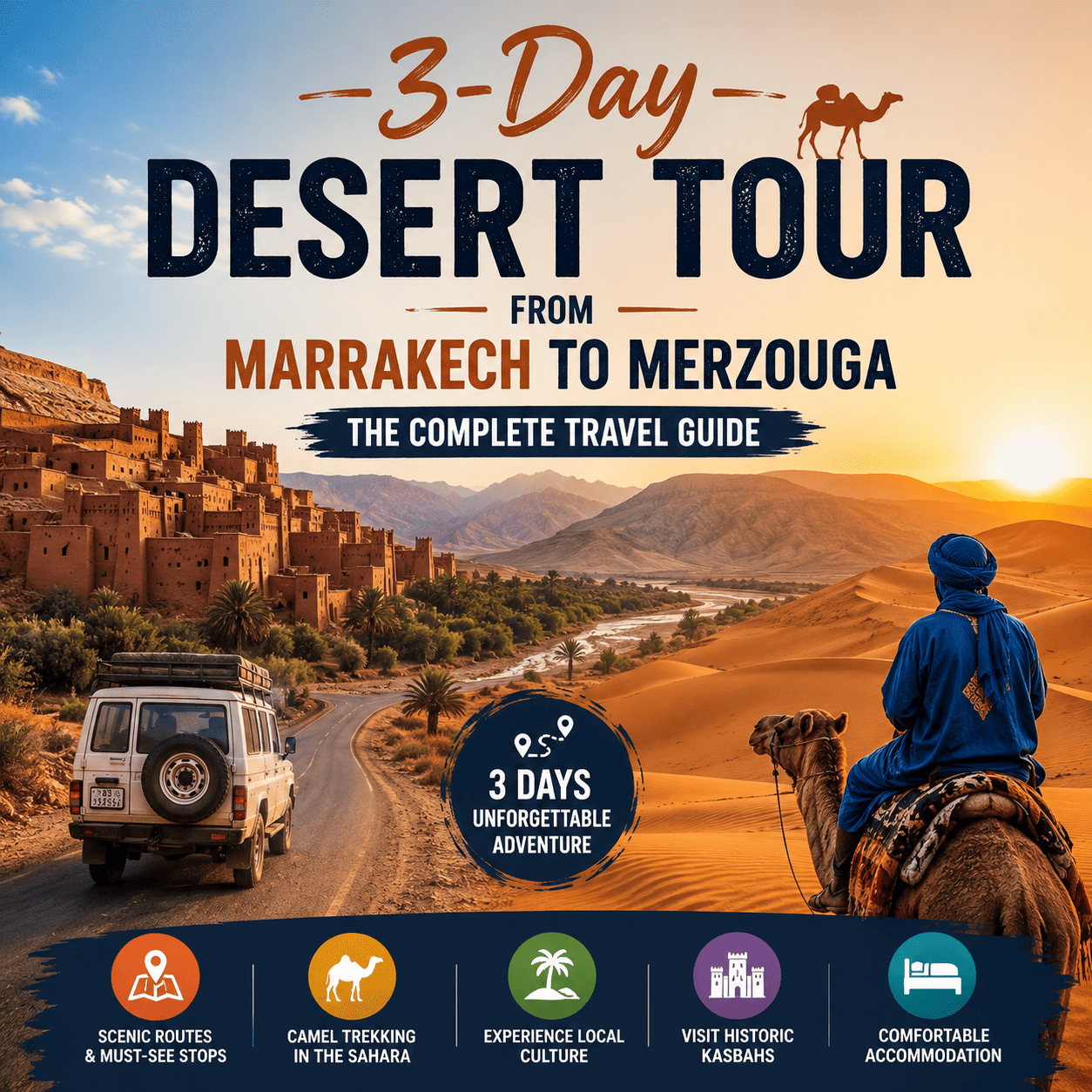
If there is one journey that captures the soul of Morocco, it is the 3-Day Desert Tour from Marrakech to Merzouga. In just three unforgettable days, you trade the buzzing souks and rooftop calls to prayer of Marrakech for snow-dusted mountain passes, fortified mud-brick kasbahs, palm-filled gorges, and finally the towering golden dunes of the Sahara. It is, without exaggeration, Morocco’s most beloved adventure.
Merzouga is a small Berber village on the eastern edge of the country, famous for sitting at the foot of Erg Chebbi, a sea of wind-sculpted dunes that rise more than 150 metres into the sky. This is the Sahara most travellers picture in their dreams: endless sand glowing copper at sunrise, camel caravans tracing the ridgelines, and a night sky so thick with stars it feels close enough to touch.
What makes this route so special is its sheer variety. You do not simply drive to the desert. You climb the High Atlas Mountains over the legendary Tizi n’Tichka pass, walk through the UNESCO-listed kasbah of Ait Ben Haddou, follow the rose-scented Dades Valley, and squeeze through the dramatic cliffs of the Todra Gorge. Every hour brings a new landscape, a new colour, a new story.
At Dahbi Morocco Tours, a licensed and locally owned company based in Morocco, we have guided travellers from the USA, the UK, and across Europe along this route since 2019. Our private 3-day desert tours are led by professional Berber drivers who were born in these valleys and know every village, viewpoint, and tea house along the way. The result is not a rushed tourist run, but a warm, personal journey into the heart of the country.
This complete travel guide walks you through everything you need to know before you go: the day-by-day itinerary, the attractions you will see, what is included, what to pack, the best time to travel, and honest answers to the questions first-time visitors ask most. Whether you are dreaming, planning, or ready to book, you will leave this page knowing exactly what to expect from your Marrakech to Merzouga desert tour.
Let’s begin where every great Moroccan story begins, with the open road heading south.
01Why Choose a 3-Day Desert Tour from Marrakech to Merzouga?
Ask any Morocco specialist which trip they recommend most, and the answer is almost always the same. The 3-Day Desert Tour from Marrakech to Merzouga is the single most popular desert experience in the country, and for good reason. It packs the very best of southern Morocco into a window short enough for a long weekend yet long enough to feel like a real expedition.
Unmatched popularity and proven appeal
This is the route that put Moroccan desert travel on the map. Thousands of travellers complete a Marrakech to Merzouga desert tour every season, which means the road is well established, the stops are well chosen, and the camps are genuinely tested. You are following a path refined over decades, not an experiment.
Scenic diversity in a single trip
Few journeys on earth change so dramatically in so few hours. In a single tour you cross:
- Alpine mountain scenery in the High Atlas, often with snow on the peaks
- Ancient earthen kasbahs that look unchanged for centuries
- Lush green oases and palm groves fed by mountain rivers
- Rugged red canyons and towering gorge walls
- And finally, the vast, silent dunes of the Sahara
That contrast is the magic. The desert feels even more astonishing because you arrive there through mountains and valleys.
Real cultural experiences
This is not a tour that keeps you behind glass. You share mint tea with local families, hear Berber spoken in mountain villages, watch artisans at work, and sleep under the care of desert hosts who have lived in the Sahara their whole lives. The culture is not a performance here. It is daily life, generously shared.
Genuine value for money
A 3-day tour typically includes transport, accommodation, a desert camp, camel trekking, and most meals. When you compare the cost against booking each element separately, the value is hard to beat, especially on a private tour where the vehicle and driver are dedicated entirely to you.
Why three days is the sweet spot
Could you reach Merzouga in two days? Technically yes, but you would spend almost all of it in the car. Could you take five days? Absolutely, and it is wonderful if you have the time. But three days is the ideal balance for most travellers. It gives you a full desert night, two sunsets and a sunrise over the dunes, and enough breathing room to stop, walk, and soak it in, without ever feeling rushed. For most visitors, the 3-Day Desert Tour from Marrakech to Merzouga is simply the smartest use of a short Moroccan holiday.
02Overview of the Marrakech to Merzouga Route
Before we go day by day, here is the journey at a glance. The route forms a loop that begins and ends in Marrakech, heading deep into the southeast of Morocco and back.
| Day | Route | Highlights |
|---|---|---|
| Day 1 | Marrakech → Tizi n’Tichka → Ait Ben Haddou → Ouarzazate → Dades Valley | High Atlas crossing, UNESCO kasbah, film studios, Valley of Roses, overnight in Dades |
| Day 2 | Dades Valley → Todra Gorge → Tinghir → Erfoud → Merzouga | Towering gorge cliffs, palm oases, fossil town, camel trek into Erg Chebbi, sunset and overnight desert camp |
| Day 3 | Merzouga → Tinghir/Ouarzazate → Tizi n’Tichka → Marrakech | Sahara sunrise, desert breakfast, scenic return through valleys and mountains |
The full loop covers roughly 1,000 kilometres of driving. It sounds like a lot, but the road is genuinely the experience here, every bend opens onto something worth photographing.
03Day 1 – Marrakech to Dades Valley
Your adventure begins early. After a morning pickup from your riad or hotel, you leave the red walls of Marrakech behind and head south toward the mountains. Within an hour the city fades and the High Atlas rises ahead, vast and blue on the horizon.
Crossing the High Atlas Mountains
The morning is all about the climb. The road winds upward through Berber villages clinging to the hillsides, terraced fields, and walnut groves. The air cools, the views widen, and the sense of leaving the ordinary behind sets in fast.
Tizi n’Tichka Pass
At 2,260 metres, the Tizi n’Tichka is the highest major mountain pass in North Africa accessible by road. It is a thrilling, switchback-laced ascent with viewpoints that beg for a photo stop. In winter you may even see snow lining the roadside. Your driver knows the best places to pause, so keep your camera close.
Ait Ben Haddou Kasbah
Descending the far side, you reach one of Morocco’s most iconic sights: Ait Ben Haddou. This fortified village of reddish earthen towers is a UNESCO World Heritage Site and has starred in countless films, from Gladiator to Game of Thrones. You will cross the riverbed and climb through its narrow lanes for sweeping views from the top.
Ouarzazate
Next comes Ouarzazate, nicknamed the “door of the desert” and the “Hollywood of Africa” thanks to its famous film studios. It is a relaxed town and a natural place to stretch your legs, grab lunch, and glimpse the Taourirt Kasbah before continuing east.
Valley of Roses
As the afternoon unfolds, the route passes through the Valley of Roses near El Kelaa M’Gouna. Each spring the valley bursts into pink bloom, and the region is famous for its rosewater and rose-petal products. Even outside the flowering season, the green ribbon of cultivation against bare hills is a beautiful sight.
Dades Valley
By evening you arrive in the Dades Valley, your home for the night. The valley is famous for its dramatic rock formations, the wind-carved “monkey fingers,” and the spectacular hairpin road that snakes up the gorge. Settle into your hotel, enjoy a warm Moroccan dinner, and rest, day two is even more spectacular.
Practical insight: Day one involves the most driving of the trip, but it is broken up by frequent stops. Sit on the right side of the vehicle for the best valley views in the afternoon, and keep a light layer handy, the mountain passes can be cool even when Marrakech is warm.
04Day 2 – Dades Valley to Merzouga Desert
This is the day you have been waiting for, the day you reach the Sahara. After breakfast you continue east, and the landscape grows wilder and more elemental with every kilometre.
Todra Gorge
Your first stop is the breathtaking Todra Gorge. Here, sheer limestone walls soar up to 300 metres on either side of a narrow river, leaving just a sliver of sky above. You can walk along the canyon floor with the cool stream beside you, watching local life unfold and rock climbers testing the cliffs. The scale is humbling.
Berber Villages
Between the gorges and the desert, the road threads through small Berber villages and palm-shaded oases such as Tinghir. These communities have farmed the same plots for generations. Pausing here gives you a window into rural Moroccan life that few travellers slow down to appreciate.
Erfoud
As the greenery thins and the horizon flattens, you reach Erfoud, a desert town famous for date palms and ancient marine fossils. The surrounding rock is studded with 350-million-year-old fossils, polished into tabletops and ornaments. It is a fascinating reminder that this sea of sand was once an actual sea.
Arrival in Merzouga
By late afternoon you arrive at the edge of Merzouga, and there it is, Erg Chebbi rising from the flat desert floor like a frozen golden wave. The first sight of the dunes stops most travellers in their tracks. This is the moment the whole journey has been building toward.
Camel Trekking Experience
Now the pace slows to the rhythm of the desert. You climb aboard a camel and set off in a caravan over the dunes toward camp. The gentle sway, the soft crunch of sand, the long shadows stretching behind you, this is desert travel exactly as it has been done for centuries. The camel trek usually lasts about an hour and is one of the most photographed experiences of the entire trip.
Sunset Over Erg Chebbi Dunes
Reaching the high dunes, you dismount and climb the last ridge on foot to watch the sun melt into the horizon. The sand shifts through every shade of gold, amber, and deep rose as the light fades. It is silent, vast, and genuinely moving, the kind of moment you carry with you for years.
Overnight Luxury Desert Camp
As night falls, you arrive at your desert camp nestled among the dunes. After a traditional dinner of tagine and Berber bread, the evening comes alive with the rhythm of drums around a fire. Then the sky takes over. With no light pollution for miles, the Milky Way arches overhead in dazzling clarity. You drift to sleep in your tent wrapped in the deep, complete silence of the Sahara, a stillness most people have never experienced in their lives.
05Day 3 – Merzouga to Marrakech
The final day begins before dawn, and it may be the most beautiful morning of your trip.
Sahara Sunrise
Rise early and climb a nearby dune to watch the sun break over the Sahara. The desert is cool and utterly quiet at this hour, and as the first light spills across the sand, the dunes glow pink and then brilliant gold. Sunrise over Erg Chebbi is, for many travellers, the single most unforgettable sight of the whole journey.
Breakfast in the Desert
Back at camp, a simple, satisfying breakfast awaits, fresh bread, eggs, olives, and hot mint tea. You eat with sand still on your shoes and the dunes glowing behind you, savouring the last moments of desert calm before the road calls again.
The Return Journey
You then make your way back by camel or 4×4 to meet your vehicle, and begin the drive back toward Marrakech. The return follows much of the same legendary route in reverse, but the light is different, the perspective is new, and there is time to reflect on everything you have seen.
Scenic Stops
The way home includes comfortable rest stops for lunch and photos, often retracing the valleys, the Tizi n’Tichka pass, and the mountain panoramas. Many travellers find the journey back surprisingly peaceful, a chance to watch Morocco’s landscapes unspool one last time.
Arrival in Marrakech
You arrive back in Marrakech in the evening, tired in the best possible way and dropped right at your hotel or riad. Three days, a thousand kilometres, mountains, gorges, oases, and one extraordinary night in the Sahara, all behind you, and all unforgettable.
06Top Attractions You Will Visit
Every stop on this route has its own history and character. Here is a closer look at the landmarks that make the Marrakech to Merzouga desert tour so special.
High Atlas Mountains
The High Atlas is the highest mountain range in North Africa, stretching across Morocco like a great spine. Home to Berber communities for thousands of years, its slopes are dotted with terraced fields and stone villages. Crossing it is the dramatic opening act of your desert tour.
Ait Ben Haddou
This fortified ksar of clustered earthen homes is one of the finest surviving examples of southern Moroccan earthen architecture. A UNESCO World Heritage Site since 1987, it once guarded a key caravan route between the Sahara and Marrakech. Its timeless silhouette has made it a favourite of filmmakers worldwide.
Ouarzazate
Known as the gateway to the desert, Ouarzazate is home to Atlas Studios, one of the largest film studios in the world. The town also boasts the grand Taourirt Kasbah, a former residence of the powerful Glaoui family. It blends cinematic glamour with authentic southern Moroccan life.
Dades Valley
The Dades Valley is celebrated for its rose cultivation, its lush riverside greenery, and its astonishing geology, including the famous “monkey fingers” rock formations. The winding road through the gorge is considered one of the most scenic drives in all of Morocco.
Todra Gorge
Carved over millennia by the Todra River, this canyon features some of the most dramatic rock walls in the country, rising hundreds of metres almost vertically. It is a magnet for hikers and rock climbers, and a serene place to walk in the shadow of towering stone.
Erfoud
Erfoud is the fossil capital of Morocco and a key gateway to the dunes. Its surrounding desert hides marine fossils from a time when the region lay beneath an ancient ocean. The town is also famous for its annual date festival celebrating the harvest.
Merzouga
Merzouga is the quiet Berber village that serves as the launch point for desert adventures. Once a remote settlement, it has become Morocco’s most famous desert destination, beloved for its access to Erg Chebbi and its warm desert hospitality.
Erg Chebbi Dunes
The crown jewel of the trip. Erg Chebbi is a vast field of dunes reaching up to around 150 metres in height, shaped endlessly by the wind. At sunrise and sunset the sand shifts through extraordinary colours. Camel trekking across Erg Chebbi and sleeping beneath its stars is the experience travellers remember most.
07What Is Included in a Typical 3-Day Desert Tour?
Knowing exactly what is covered helps you plan your budget and packing. While details vary between operators, a quality private 3-day desert tour generally breaks down like this.
| Usually Included | Usually Not Included |
|---|---|
| Private air-conditioned vehicle (4×4 or minivan) | International flights to Morocco |
| Professional English-speaking Berber driver | Lunches along the route |
| Hotel and riad pickup and drop-off in Marrakech | Drinks and bottled water (some camps provide it) |
| One night in a hotel in the Dades Valley | Entrance fees to some monuments or museums |
| One night in a desert camp near Erg Chebbi | Tips for the driver and camp staff (appreciated) |
| Camel trekking into the dunes at sunset | Optional activities (quad biking, sandboarding) |
| Dinner and breakfast at the hotel and the camp | Travel insurance |
| Fuel, tolls, and all driving costs | Personal souvenirs and shopping |
Always confirm inclusions in writing before you book. At Dahbi Morocco Tours we lay out every detail clearly, so there are no surprises along the way.
08Luxury vs Standard Desert Camps
Where you sleep in the desert shapes the whole experience. Both standard and luxury camps are wonderful, but they offer different levels of comfort. Here is an honest comparison to help you choose.
| Feature | Standard Camp | Luxury Camp |
|---|---|---|
| Accommodation | Simple Berber tents with basic beds | Spacious tents with quality beds, rugs, and furnishings |
| Bathrooms | Shared facilities, often basic | Private en-suite bathrooms with hot showers |
| Dining | Traditional shared dinner and breakfast | Refined multi-course meals, sometimes private dining |
| Comfort | Authentic and rustic | High comfort with heating and quality bedding |
| Photography | Beautiful dune setting | Premium settings, decor, and styled spaces |
| Pricing | Most affordable option | Higher price for added comfort and privacy |
For first-time visitors who want comfort and privacy, a luxury desert camp in Merzouga is well worth the upgrade. For budget-conscious travellers and those chasing pure authenticity, a standard camp delivers the same magical dunes and starry skies at a lower cost. Whatever you choose, the sunrise is free.
09Best Time to Take a Marrakech to Merzouga Desert Tour
The Sahara is a year-round destination, but each season has its own personality. Understanding the weather helps you pick the right time and pack the right clothes.
Spring (March to May)
Widely considered the best time to visit. Days are warm and pleasant, the Valley of Roses blooms, and the desert is comfortable both day and night. It is also a popular season, so book early.
Summer (June to August)
Summer in the Sahara is hot, with daytime temperatures often soaring past 40°C. Tours still run, but activities focus on early mornings and evenings. Nights cool down pleasantly. Ideal if you tolerate heat well and want fewer crowds.
Autumn (September to November)
The second sweet spot. The fierce summer heat fades, skies are clear, and the desert glows beautifully. Comfortable temperatures and golden light make autumn a favourite for photographers.
Winter (December to February)
Winter brings mild, sunny days and genuinely cold desert nights, sometimes near freezing. The High Atlas may be snow-capped, which is stunning. Pack warm layers, and you will enjoy crisp air and dramatic scenery with smaller crowds.
| Season | Daytime Temp | Night Temp | Verdict |
|---|---|---|---|
| Spring | 20–30°C | 10–15°C | Best overall, mild and scenic |
| Summer | 35–45°C | 20–25°C | Hot days, plan around early/late hours |
| Autumn | 20–32°C | 10–18°C | Excellent, clear skies and golden light |
| Winter | 15–22°C | 0–8°C | Cool days, cold nights, fewer crowds |
Temperatures are approximate and vary year to year. Whatever the season, desert nights are always cooler than days, so layers are essential.
10What to Pack for the Sahara Desert
Packing smart makes the trip more comfortable. You do not need much, but a few key items make all the difference in the desert. Use this checklist as you prepare.
Clothing
- Lightweight, breathable clothes for warm daytime driving
- A warm jacket or fleece for cold desert nights, essential in winter
- Long sleeves and trousers for sun protection and modesty
- A scarf or shawl to shield your face from sand and sun
- Comfortable closed shoes and a pair of sandals for the dunes
- A swimsuit if your hotel or camp has a pool
Essentials
- Sunglasses, sunscreen, and a wide-brimmed hat
- Reusable water bottle to stay hydrated
- Power bank, as charging may be limited in the desert
- Camera or phone with plenty of storage for photos
- Personal medications and a small first-aid kit
- Lip balm and moisturiser, the desert air is very dry
- Wet wipes or hand sanitiser for convenience
- Cash in Moroccan dirhams for tips, drinks, and souvenirs
- A small daypack for overnight items at the camp
11Travel Tips for First-Time Visitors
A few practical pointers will help your first Moroccan desert tour go smoothly.
- Currency: The Moroccan dirham (MAD) is the local currency. Carry cash for tips, roadside stops, and small purchases, as cards are rarely accepted in remote areas. ATMs are available in larger towns like Ouarzazate.
- Clothing: Morocco is a Muslim country, so modest dress is appreciated, especially in villages. Light, loose layers keep you comfortable across the temperature swings of mountain, valley, and desert.
- Photography: The landscapes are spectacular, so bring plenty of storage. Always ask before photographing local people, and respect anyone who declines. Sunrise and sunset offer the best light.
- Internet: Mobile coverage is good in towns but patchy in the deep desert. Many camps now offer limited Wi-Fi, but treat the night in the Sahara as a chance to disconnect and look up at the stars instead.
- Safety: Morocco is one of the safest countries in North Africa for travellers, and Merzouga is welcoming and secure. Stick with your guide on the dunes, stay hydrated, and use common travel sense.
- Local culture: Hospitality is central to Berber and Moroccan life. Accept the mint tea, learn a few words of greeting, and tip your driver and camp staff if you enjoyed the service, it is genuinely appreciated.
12Why Book with Dahbi Morocco Tours?
Choosing the right company transforms a good trip into an extraordinary one. Here is why thousands of travellers from around the world trust Dahbi Morocco Tours with their desert adventure.
- Genuine local expertise: We are a licensed, locally owned Moroccan company founded in 2019. Our team, including co-founder Houssain Dahbi, was born and raised in these landscapes. We do not read the desert from a guidebook, we live it.
- Truly private tours: Your vehicle, your driver, and your itinerary are yours alone. No crowded buses, no rigid group schedules, just travel at your own pace.
- Professional Berber drivers: Our experienced drivers, including Mustapha and Mohammed, are safe, friendly, and deeply knowledgeable. They double as local guides, sharing stories and secret viewpoints along the way.
- Authentic experiences: We connect you with real Moroccan culture, family-run guesthouses, local cuisine, and genuine Berber hospitality, not staged tourist traps.
- Flexible itineraries: Want an extra stop, a slower morning, or a special dietary need accommodated? We tailor the journey around you.
- Quality accommodations: From comfortable valley hotels to handpicked desert camps, we choose places that are clean, welcoming, and well located.
- Responsive customer support: From your first message to your safe return to Marrakech, our team is reachable, helpful, and committed to making your trip seamless.
Ready to experience the Sahara the right way? Explore the full itinerary and reserve your spot on our 3-Day Desert Tour from Marrakech to Merzouga, or get in touch to plan a private journey built entirely around you. Your desert adventure starts with a single message.
13Other Popular Tours from Marrakech
Love the sound of the desert but have a little more or a little less time? Marrakech is the perfect launch pad for a whole range of journeys. Browse the full collection on our tours from Marrakech page, or consider one of these traveller favourites:
For travellers with more timeThe 5-Day Tour from Marrakech to Merzouga expands the same legendary route with extra stops, slower mornings, and deeper exploration of the valleys and dunes. Best for visitors who want to savour the south without rushing.
For a quicker desert escapeThe 2-Day Tour from Marrakech to Zagora reaches the dunes of Zagora in a single overnight. Ideal for those short on time who still crave a taste of the Sahara and a night under the stars.
For a one-way adventure ending in FesThe Marrakech to Fes Desert Tour (3 Days) crosses the desert and finishes in the imperial city of Fes instead of looping back. Perfect for travellers planning to continue their Moroccan journey northward.
Not sure which fits you best? Tell us your dates and interests, and we will recommend the perfect route.
14Frequently Asked Questions
Is a 3-day desert tour from Marrakech worth it?
How long is the drive from Marrakech to Merzouga?
Can children join the tour?
Are luxury camps available?
Is camel trekking included?
What should I wear in the desert?
Is Merzouga safe?
What is the best month to visit?
How cold is the desert at night?
Can vegetarians join the tour?
Do I need a 4×4 for this tour?
How much luggage can I bring?
Will there be Wi-Fi and phone signal?
Can the itinerary be customised?
How do I book a 3-day desert tour from Marrakech to Merzouga?
15Final Thoughts
Some journeys stay with you long after you unpack. The 3-Day Desert Tour from Marrakech to Merzouga is one of them. In just three days you cross the soaring High Atlas, wander through ancient kasbahs, follow rivers through dramatic gorges, and finally stand at the edge of the great Sahara as the sun sets the dunes on fire.
It is the contrast that makes it magical. The cool mountain air gives way to warm desert evenings. The bustle of Marrakech dissolves into the deepest silence you have ever heard. And that night under a sky overflowing with stars, with the dunes glowing softly in the moonlight, becomes the memory you describe to everyone back home.
This is why the Marrakech to Merzouga desert tour remains Morocco’s most loved adventure, year after year. It is not just a drive to the desert. It is a complete journey through the country’s most beautiful and meaningful landscapes, shared with people who call them home.
At Dahbi Morocco Tours, we pour genuine local knowledge, warmth, and care into every trip. As a licensed, locally owned company with professional Berber drivers and fully private, flexible itineraries, we make sure your desert experience is comfortable, authentic, and unforgettable from the first kilometre to the last.
So if the Sahara has been calling, now is the time to answer. See the full itinerary on our 3-Day Desert Tour from Marrakech to Merzouga page, or message our team today to plan your private journey into the dunes. The mountains, the gorges, and the golden sands of Merzouga are waiting.